




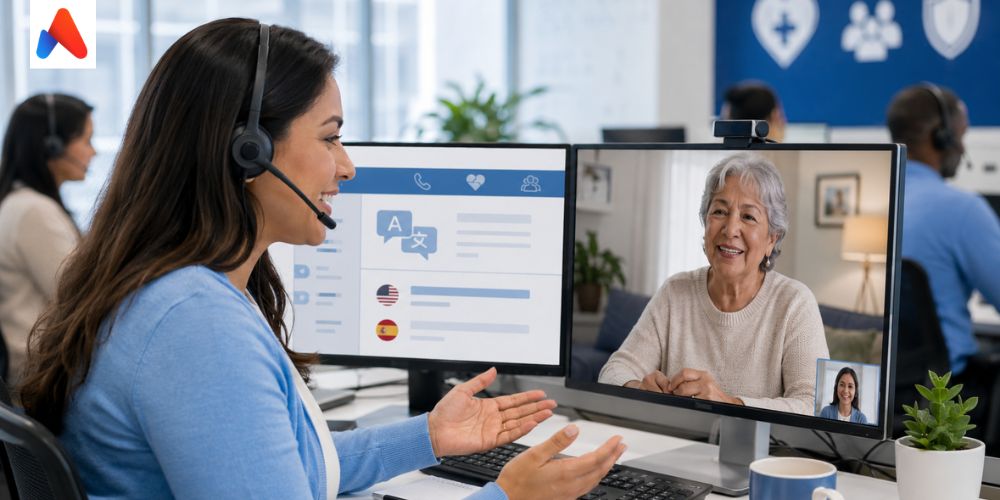
A Medicare plan can translate every required document correctly and still frustrate a member who prefers another language. The member calls about a prescription benefit. The first agent cannot handle the conversation, so an interpreter has to be located. The member repeats what they already said. A transfer follows because the question touches another department, and the receiving team lacks the same language capability.
Nothing in that sequence is a translation failure. It is an operating-model failure, and the distinction matters more than it might first appear.
Multilingual Medicare support is often treated as a matter of converting English materials into other languages. Federal requirements already go further. Medicare Advantage plans must provide interpreters for non-English-speaking and limited-English-proficient members, and CMS requires interpreters to connect with customer service representatives and answer plan questions within eight minutes during test calls. Plans must also translate specified materials whenever a non-English language is the primary language of at least 5% of people in a plan benefit package service area, with comparable requirements for Part D sponsors.
Those rules set a baseline. They do not answer the harder operational question: how should a plan design multilingual service so that language never becomes another transfer, another wait, or another source of misunderstanding?
Key takeaway: Translation makes information available in another language. Multilingual operations make the entire service journey usable in that language — and CMS increasingly measures the difference. Interpreter performance now feeds directly into the Part C and D Star Ratings customer service domain, and plans holding four stars or higher receive a 5% quality bonus on their Medicare Advantage reimbursement. A slow interpreter connection is no longer just a member-experience problem; it is a revenue problem.
Customer Service Domain
+5% Quality Bonus
Translation, Interpretation, and Bilingual Service Are Not Interchangeable
Healthcare organizations often use these three terms as synonyms. Operationally, they solve different problems. Translation converts written material — notices, plan documents, digital content — and is required regardless of how phone service is staffed. Interpretation enables live spoken communication when a bilingual agent is not available, and it remains essential for lower-volume languages. Bilingual member service lets a trained representative conduct the entire interaction directly, which works best for recurring, higher-volume inquiries.
No single mechanism serves every need. The right mix depends on member population, call complexity, demand volume, and service hours — most plans ultimately need all three working together.
Why Language Adds More Than a Conversational Barrier
Medicare interactions combine administrative complexity with high personal stakes. A member calling about network status, prior authorization, a coverage denial, or a coinsurance amount is not just asking a factual question — they are trying to protect their access to care. The challenge, then, is not conversational fluency alone. It is domain fluency: language plus Medicare knowledge plus plan knowledge plus workflow discipline plus empathy. A bilingual agent who speaks excellent Spanish but does not know Medicare terminology can create as much friction as a fluent Medicare agent who cannot communicate with the member at all.
“The best clinical recommendations are only effective when they are truly understood.” – Tram Thai, PharmD, VP of Clinical Operations
She has also written about coordinating her own mother’s care across a language and generational gap, and about a medication misunderstanding that nearly caused harm — a reminder that the operational failures described here are rarely abstract. An estimated 13.6 million Medicare beneficiaries nationally report speaking English less than “very well,” a population too large to serve through translated documents alone.
Ameridial pairs Medicare-trained representatives with bilingual expertise and interpreter-backed communication capabilities to deliver member support that combines language access with deep Medicare knowledge.
Language Access Is Also a Queue-Design Problem
Routing is one of the least discussed parts of multilingual support. An English-speaking member reaches the correct benefit-support queue directly. A Spanish-speaking member enters the general queue, states a language preference, waits for an interpreter, explains the issue, and is then transferred to a specialist who may not share the same language capability. Both eventually get help, but not the same experience.
Plans should evaluate language access through a service-parity lens: are wait times, transfer counts, handle times, abandonment, and first-contact resolution meaningfully different by language? When demand justifies dedicated language support, plans should implement bilingual queues for high-volume languages, use skill-based routing to connect members with bilingual agents, integrate interpreter services for lower-volume languages, and capture each member’s language preference once so it follows them through every transfer. This matters most during Annual Enrollment, when volume and decision complexity magnify any routing weakness. Ameridial’s Open Enrollment Support Services build multilingual capacity into seasonal workforce planning rather than treating it as an exception case.
The 5% Threshold Is a Compliance Trigger, Not a Staffing Plan
The federal 5% translation threshold is important, but it should not double as a workforce forecast. A language can fall below that threshold and still generate enough call volume to affect service levels; a language that clears it for document translation may not justify a staffed queue in every operating hour. The forecast should instead rely on actual interaction data — language preference, interpreter usage, handle time, transfer frequency, geographic concentration — so leaders can decide which languages need dedicated capacity, which need shared coverage, and which are served efficiently through interpreters alone. That is workforce engineering, not regulatory box-checking.
Where Multilingual Medicare Operations Commonly Break
Five points in the member journey deserve particular attention. During enrollment, members often need live clarification even when plans provide translated materials, and AEP’s compressed timeline increases the urgency. During benefit explanation, agents must clearly explain terms such as deductible, formulary, and prior authorization—concepts that challenge even native English speakers—without providing unauthorized interpretations. Ameridial designed its Benefit Management Support services to help representatives deliver accurate, compliant benefit explanations across every interaction. Pharmacy questions require the same Part D and formulary access English-language teams have; a bilingual front door that routes every pharmacy question back to an English-only specialist defeats its purpose. Appeals and grievances can emerge mid-call, and agents need to recognize the workflow trigger regardless of language. Finally, member onboarding deserves attention after AEP ends — a capacity gap right when new members are learning to use their coverage, which Ameridial’s Member Onboarding & Education Services are designed to prevent.
Quality Assurance Cannot Be an Afterthought
QA becomes harder when leaders cannot directly evaluate the language of the interaction. Translating select calls after the fact is a weak substitute for language-capable QA resources on priority languages, paired with structured processes for less common ones. Multilingual QA should evaluate the same fundamentals as English QA—accuracy, authentication, documentation, and escalation recognition—while also assessing language-specific factors, including whether agents used understandable terminology, preserved the intended meaning instead of relying on mechanical translation, and kept members from switching back to English during transfers. Calibration across QA, training, and bilingual supervisors matters, because two linguistically correct agents can still give materially different explanations of the same benefit.
A Decision Framework
| Demand Pattern | Operational Response |
|---|---|
| Consistently high | Dedicated bilingual staffing |
| Moderate but predictable | Shared bilingual skill groups |
| Low or highly variable | Qualified interpreter services |
| Complex, repetitive interactions | Direct bilingual servicing (reduce handoffs) |
| Written communication required | Translation workflow (any call model) |
| Regulated escalation involved | Language capability preserved through full path |
Most plans land on a hybrid: bilingual agents for high-volume languages, interpreters for everything else, translation workflows for required materials. The goal is not maximizing bilingual headcount — it is matching mechanism to need, and measuring whether it closes the gap.
Language Access Is an Experience Design Decision
CMS sets the floor for interpreter availability and translated materials. A plan can clear that floor and still create unnecessary member effort if language preference does not survive a transfer, if bilingual teams cannot see the same knowledge base as English teams, or if leadership cannot see performance broken out by language at all. Closing that gap is what turns multilingual support from a compliance line item into a measurable driver of retention, Star Ratings performance, and member trust.
Is your language access model ready for AEP? Before October 15, it’s worth asking four questions of your own operation. Does language preference survive a transfer, or does a member get asked the same question twice? Are wait times, transfer counts, and first-contact resolution tracked separately by language, or only in aggregate? Can a bilingual agent see the same knowledge base and pharmacy data as an English-language specialist? And if a CMS test caller placed a Spanish- or Mandarin-language call to your center today, would it clear the eight-minute interpreter-connection standard on the first attempt? A “no” to any of these is a service-parity gap, and AEP is the worst time to discover one.
Is Your Language Access Model Ready?
Ameridial helps Medicare and Medicare Advantage organizations close that gap before it shows up in a Star Ratings audit or a member complaint. Request a Language Access Service-Parity Assessment — a structured review of your current interpreter connection times, bilingual staffing coverage, and routing logic against CMS’s Accuracy and Accessibility standards — or explore Ameridial’s Medicare support services to see how bilingual staffing, interpreter integration, and translation workflow come together under one team.