




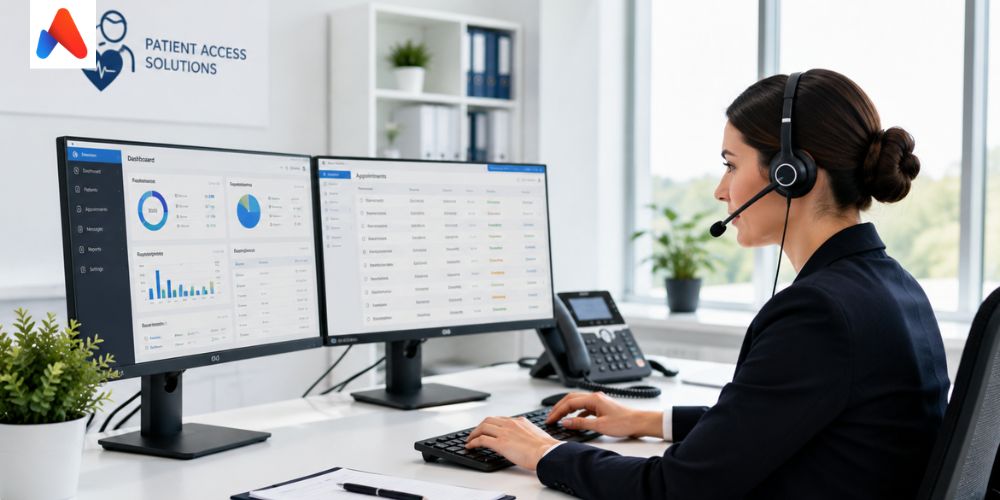
A rural clinic administrator in Kansas once joked that her front desk had three jobs. Check patients in, answer forty calls an hour, and will the phone system not to crash. The joke landed because it was true. Still, nobody else in the room found it funny. That is rural healthcare in 2026. Staff wear five hats, budgets wear thin, and patients wait longer for a callback than for their actual appointment. The workforce crisis is not a forecast anymore. It is the daily operating condition of thousands of rural clinics and hospitals. It is also forcing a question that used to sound heretical. Does every patient access role really need a body in the building?
The Rural Healthcare Workforce Shortage Is Not a Future Risk
Rural healthcare workforce shortage headlines usually focus on physicians, and for good reason. Rural America holds roughly 20 percent of the U.S. population. Yet only about 10 percent of the nation’s physicians serve that population, according to research summarized by CWS Health. That gap alone would strain any system. Then layer in the facility data, and the picture gets worse. Chartis’ 2026 Rural Health State of the State report offers a stark number. Specifically, 417 rural hospitals now sit at risk of closure. More than 40 percent of rural hospitals are operating at a financial loss. In fact, over a third of hospitals in states that never expanded Medicaid fall into that at-risk category.
The service cuts tell an even sharper story. Chartis researchers documented that more than 300 rural hospitals have dropped obstetric services entirely. A similar number have eliminated general surgery. Maternity care has absorbed a particularly hard hit. Becker’s Hospital Review reported that only 41 percent of U.S. rural hospitals still provide labor and delivery services. Closures have proceeded at a pace of more than two per month over four years. Consequently, expecting mothers in a dozen states now travel 50 minutes or longer for delivery care. None of this happens because rural leaders stopped caring. It happens because staffing a full on-site team around the clock is hard enough already. Doing that in a county of 4,000 residents turns into a math problem nobody has solved.
300+
~300
40%+
Why On-Site-Only Staffing Quietly Breaks Rural Clinics
Every role does not carry the same weight, yet on-site-only staffing treats them as if they do. A phlebotomist needs to be in the building. A surgeon needs to be in the building too. However, the person confirming tomorrow’s appointments does not strictly need to sit at that same front desk. When rural clinics insist otherwise, they compete for the same tiny labor pool. That same pool also has to staff the pharmacy, the school, and the county office down the street. Eventually, the result is chronic vacancy, and chronic vacancy always lands on whoever stayed behind.
Rural Provider Burnout and the Administrative Burden Nobody Budgeted For
Rural provider burnout and administrative burden go hand in hand. The data backs up what clinicians already feel in their shoulders by 4 p.m. MGMA’s 2026 Regulatory Burden Report surveyed leaders from more than 230 medical group practices. Seventy-seven percent named regulatory burden a major driver of physician burnout. Separately, Medscape’s 2025 survey found that 62 percent of physicians report burnout. Bureaucratic workload and EHR demands ranked as the top two contributors. In a rural setting, there is rarely a scribe or a second scheduler to absorb that load. Typically, there is rarely an overflow team either. The physician effectively becomes the scheduler and the referral coordinator. Occasionally, that same physician returns a lab-result call at 7 p.m.
Anders Gilberg, senior vice president of government affairs at MGMA, summarized the stakes plainly. Regulatory and administrative pressure, he said, is now “threatening physician payment.” That single line captures a feeling rural leaders already know well. Administrative overload is not a paperwork inconvenience. It is a staffing crisis wearing a compliance costume. Predictably, it lands hardest in communities that can least absorb another vacancy. Many Federally Qualified Health Centers already serve entire counties with a skeleton crew.
Remote Patient Access Support in Rural Health Systems: What Actually Changes
Remote patient access support rural health systems now rely on does not replace the clinician. Instead, it replaces the assumption that scheduling and verification calls must happen inside the exam room. A remote patient access team can confirm appointments and run eligibility checks. That same team can route urgent calls to the right nurse line. Meanwhile, none of it adds a single square foot to a rural building that likely has none to spare. Rural leaders who resist this shift often worry about losing the local, personal touch patients expect. That concern is fair. It is exactly why the right remote model matters. Agents train on a specific clinic’s workflows, tone, and patient population, rather than a generic script.
Centralized Scheduling for Rural Clinics: One Fix, Many Ripple Effects
Centralized scheduling for rural clinics solves a problem that looks small until someone measures it. MGMA’s 2026 patient access research notes that centralized call handling frees on-site staff for in-person patients and check-in workflows. Even modest routing improvements, the research found, tend to boost first-call resolution. Notably, they also tend to reduce staff burnout in the process. A single, centrally managed medical appointment scheduling function smooths out the coverage gaps that plague small clinics. One person calling in sick no longer means every phone line goes unanswered. Furthermore, centralization gives rural systems something they rarely have: real reporting on call volume, abandonment, and peak demand. That reporting turns staffing decisions into evidence instead of guesswork.
Rural Healthcare Staffing Solutions: Choosing Between Onshore, Nearshore, and Hybrid Models
Rural healthcare staffing solutions are no longer a binary choice between hiring locally or doing without. Health systems now weigh onshore, nearshore, and hybrid models that blend both, depending on complexity and compliance sensitivity. Onshore staffing keeps oversight simple and culturally aligned, which matters for Medicare-heavy rural populations. However, onshore-only staffing runs into the exact labor scarcity that started this entire conversation. In short, rural counties rarely have a deep bench of trained healthcare administrative talent sitting idle.
What Nearshore Support Brings to Rural Health Systems
Nearshore support rural health systems increasingly use fills the gap between full local staffing and losing service altogether. A nearshore team operates in a similar time zone, often with bilingual capability built in. That team can absorb overflow scheduling calls, eligibility verification, and after-hours triage routing. It does all of that without the multi-month hiring cycle a rural HR department cannot run twice a year. This model works best paired with an onshore team handling the most clinically sensitive conversations. That way, the human touch stays local while volume overflow gets absorbed elsewhere. Ameridial structures its healthcare provider services this way, pairing onshore leadership with flexible global delivery locations. Rural and small-market clients never have to choose between quality and capacity.
A Real Rural Health System Already Tested This
Skeptics of remote and centralized support should look at one real example. Marshfield Clinic Health System runs a genuinely rural provider network across Wisconsin. Researchers built an evidence-based predictive model using more than 1.26 million appointments across 263,464 patients. The goal was targeting no-show risk and improving overbooking decisions, according to the published study. The project demonstrated that rural systems do not need a Silicon Valley budget to fix patient access. They need better data, better routing, and staff freed from repetitive scheduling tasks. Marshfield’s example shows centralized, data-driven scheduling working inside a genuinely rural, multi-site network. This did not happen inside a well-funded urban academic center.
The Uncomfortable Question Every Rural Health Leader Should Ask
So, should every patient access role stay on-site? The honest answer is no, not anymore. That holds true if the goal is keeping rural clinics open and providers sane. Clinical roles stay local because they must. Administrative and scheduling roles can flex instead. Flexing them is often the difference between a clinic that survives the next five years and one that closes. Rural health leaders do not need to abandon their community identity to solve this problem. They need a staffing model that matches each role to where it actually belongs. That beats defaulting to a policy built for a fully staffed suburban system. That system never existed in their county anyway. For a deeper look at the build-versus-outsource decision, the healthcare call center outsourcing decision guide walks through the tradeoffs.
Ready to see what a blended rural staffing model looks like for your organization? Ameridial’s healthcare provider services team designs onshore and nearshore support around three core areas. Those areas include medical appointment scheduling, eligibility verification, and care coordination and care transition support. Your rural clinic gains capacity without losing the local trust patients rely on. Book a free consultation. Let’s map a pilot program built for your county, your call volume, and your compliance requirements.