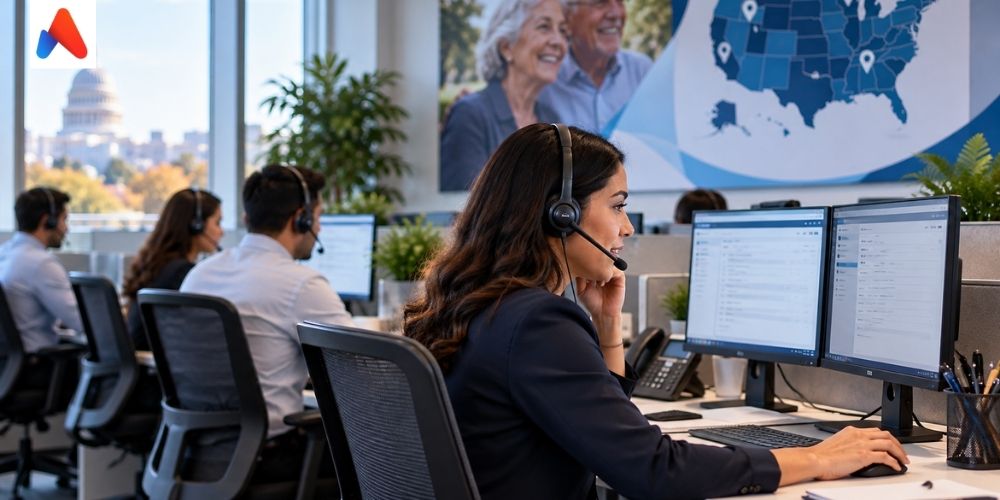





A hospital discharge planner has forty-five minutes to place a patient before the bed turns over. She calls three home health agencies. The first one rings six times, then dumps her into voicemail. The second one answers, but the intake coordinator is mid-assessment with another family. She promises a callback “sometime today.” The third agency picks up on the second ring. The coordinator confirms coverage and starts the intake packet while the planner is still on the line. Guess which agency gets the patient. Probably the next fifty referrals from that hospital go there too.
That short window is the entire business model of home health, whether operators admit it or not. Referral sources do not wait. Families do not wait. Patients recovering from surgery or a cardiac event cannot wait either. Yet most agencies still run intake the way they did a decade ago. A front-office team gets stretched across scheduling, billing questions, and referral calls. Everyone hopes nothing collides during a staffing crunch. That gap is exactly why home health agency referral intake outsourcing has become a genuine growth strategy. It is no longer just a cost-cutting afterthought. Operators want to win referrals now, not merely process them.
The Real Math Behind Home Health Agency Referral Intake Outsourcing
Intake delay is not a minor inconvenience. Referral management research, built on CMS’s own home health reporting, points to one striking number. Insufficient documentation drives more than half of the industry’s improper payments. That single statistic deserves attention from every intake manager. Much of that traceable damage starts in the first call, when details get rushed or skipped entirely. High-performing agencies convert somewhere between 65 and 75 percent of referrals into admissions. Slower competitors, meanwhile, watch strong referral sources quietly drift toward whoever answers the phone faster. Industry benchmarking also points to a two-hour response target for hospital referrals. That bar is nearly impossible to hit with a lean front office. Flu season and holiday staffing gaps make it even harder.
Add the sheer time cost of doing intake correctly. Reviewing a single referral packet thoroughly takes roughly seventy minutes on average. That figure comes from published home health workflow data. That includes checking eligibility and matching clinical needs to available capacity. Multiply that across dozens of daily referrals from multiple sources. The math stops working fast for a lean team, no matter how dedicated the staff is. This is precisely the pressure that home health call center support gets built to absorb. It gives agencies dedicated, trained capacity that does not vanish when referral volume spikes. It also frees intake coordinators to spend their time on judgment calls, not data entry.
What Home Health Call Center Support Actually Fixes at 2 A.M.
Referrals do not arrive on a nine-to-five schedule, and neither do worried families. A hospital discharge planner might fax a referral at 6 p.m. on a Friday. A son might call at 9 p.m. because his father’s oxygen concentrator started beeping. Agencies without after-hours coverage lose both moments. Both losses quietly compound into weaker trust with referral sources and families alike.
Outsourced home health call center support closes that gap. It does so without forcing an agency into round-the-clock in-house staffing, which is rarely realistic for mid-sized operators. A trained partner team answers referral calls and verifies insurance and service eligibility. That same team routes urgent clinical concerns straight to on-call nurses. Every interaction gets logged, so nothing gets lost between shifts. Meanwhile, internal staff can focus on care coordination instead of triaging phone traffic all day long. Ameridial builds its healthcare provider support services around exactly this kind of access coordination. The model pairs HIPAA-compliant intake handling with eligibility verification. Every referral needs both, before anyone schedules a single visit.
Home Health Family Communication Support: The Silent Referral Killer
Here is the part most agencies underbuild. A referral does not end when a patient gets admitted. It continues through the whole episode of care, and families ask most of the unscheduled questions. When will the nurse arrive? Why did the visit frequency change? Who do we call if Dad falls on a weekend? Unanswered questions make families anxious, and anxious families talk. Referral sources eventually hear about it, and the agency’s reputation absorbs that damage quietly, one conversation at a time.
Strong home health family communication support turns that risk into a retention advantage instead. Consistent, empathetic updates reduce confusion and catch small problems before they become big ones. Jennifer Sheets leads the National Alliance for Care at Home as CEO. She has warned that ongoing reimbursement pressure has already forced agencies to narrow service offerings. In some cases, agencies have closed entirely. That reality raises the stakes for every agency still standing. Family communication is no longer a nice-to-have; it functions as a survival skill in a shrinking, more competitive market. Ameridial built its care coordination and care transition support model for exactly this moment in the patient journey. It keeps families informed from referral through discharge, without pulling clinicians away from actual hands-on care.
The BAYADA Lesson in Abandoned Calls
Real numbers back this up better than theory does. BAYADA Home Health Care is one of the nation’s largest nonprofit home health providers. It once ran a contact center with a call abandonment rate near 20 percent. That meant roughly one in five callers, including worried family members, hung up before reaching an agent. BAYADA later modernized its contact center operations and cut that abandonment rate to 2.5 percent. That is an 87 percent reduction, according to a published case study from NiCE. It is not a marginal improvement. It marks the difference between reaching a real person during a crisis and giving up. A frustrated family calls a competitor next.
The lesson stretches well beyond one large provider, honestly. Every dropped call, every unanswered voicemail, and every vague update quietly erodes trust. Referral sources and families both notice, even when nobody files a formal complaint about it.
Building an Intake Model That Actually Wins the Referral Race
None of this argues for replacing clinical judgment with a script, and it should not. Outsourcing referral intake and family communication protects clinical staff’s time; it does not replace clinical decision-making. The most effective model pairs a trained, HIPAA-compliant contact team with the agency’s own clinicians. The contact team handles intake and family calls, while clinicians focus on assessments and hands-on care. Ameridial’s medical appointment scheduling and eligibility verification services fit directly into that division of labor. Scheduling and coverage checks rarely require a nurse’s direct involvement anyway.
Compliance matters just as much as speed in this model. A referral intake partner should document every field an auditor might ask about later. That means referral source, diagnosis, requested services, payer details, and physician orders. Skipping that discipline is exactly how agencies land on the wrong side of a documentation audit. A well-trained outsourced team treats compliance as part of the job. It is not an afterthought bolted on after the call ends.
Some agencies treat referral intake and family communication as strategic infrastructure instead of back-office overhead. Those agencies consistently outperform peers on admission conversion and referral source loyalty. Referral competition keeps tightening, and reimbursement pressure keeps growing alongside it. Therefore, the gap between fast, warm intake and slow, generic intake will only widen further. Agencies that ignore this dynamic now will feel it later. Referral volume simply moves somewhere else instead, quietly and without warning.
Ameridial has spent more than three decades building HIPAA-compliant contact center support for healthcare organizations of every size. Home health referral intake outsourcing draws on that same operational discipline. It applies that discipline to one of the industry’s most time-sensitive workflows. Explore Ameridial’s healthcare call center solutions outsourcing guide for a closer look at what modern intake support can include. A related case study on scaling patient intake for a neurodiagnostics provider shows the same principle at work. The setting differs, but the lesson about intake speed does not. Or skip ahead and talk with Ameridial’s healthcare provider support team directly. Find out what your current referral response time is actually costing you in lost admissions. A short conversation is usually enough to reveal the gap. From there, faster intake and stronger family communication can start changing your admission numbers this quarter.