




It is early August. Medicare’s Annual Enrollment Period lands on October 15, 2026. That leaves roughly ten weeks before the phones start ringing nonstop. Health plans, TPAs, and FMOs across the country are asking the same question right now. Is it too late to outsource? The honest answer lives inside the real aep call center outsourcing timeline, not in a gut feeling. A well-run ramp takes six weeks, sometimes eight, depending on licensing complexity. Miss that window, and you gamble with hold times, CMS Star Ratings, and member trust. This is the one stretch that shapes your entire plan year.
This is not a scare-tactic pitch built to rush you into a contract. Instead, it is a plain look at what actually happens once you sign. Ameridial has run Medicare AEP programs for more than three decades. In that time, we have watched plans hit this deadline with room to spare. We have also watched others miss it by two weeks and pay for it every day through early November.
How Fast Can You Outsource Before AEP? The Honest Answer
So, how fast can you outsource before AEP, realistically? Industry benchmarks put minimum viable ramp time at four to six weeks for licensed Medicare seats. That number assumes nothing goes sideways along the way. Recruiters at Hiregy, a call center staffing firm, track this pattern closely across many industries. They describe seasonal ramp timelines as running “four to six weeks, sometimes longer in regulated industries such as healthcare.” That warning applies directly to Medicare work, where compliance training adds an extra layer most other sectors never see. Meanwhile, vendors specializing in Medicare AEP staffing report something sobering. Contracted capacity for licensed seats often sells out by late August. After all, AHIP certification, state licensing, and carrier-specific training simply take real time to finish. If today is the first week of August, your organization sits right at the edge of that window. It is not comfortably inside it yet.
6-Week AEP Ramp Readiness Clock
From contract signature to October 15 go-live
Here is the part most buyers underestimate every single year. Hiring is actually the easy phase of the whole process. Onboarding, licensing verification, and CMS-compliant script training are where timelines quietly fall apart. A plan might start recruiting in early August. If it waits until mid-September to begin AHIP-aligned training, it will likely miss full readiness by October 15.
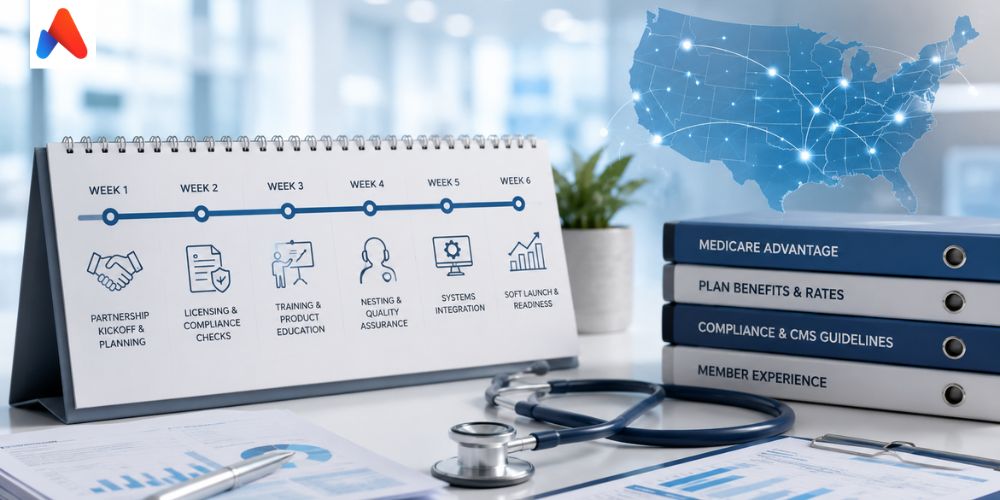
The AEP Call Center Outsourcing Timeline, Week by Week
Breaking the ramp into weekly phases makes the math less abstract. It also makes the whole plan considerably easier to defend internally.
6-Week Execution Timeline
Critical path from signature to live AEP support
Weeks One and Two: Contracting, Forecasting, and Licensing Checks
The clock starts the moment a contract gets signed, not when agents show up. During these first two weeks, a serious outsourcing partner builds a call-volume forecast from your prior AEP data. The partner also confirms which states require producer licensing for this specific work. Next, the team verifies AHIP certification status for every agent slated for your account. Consequently, plans that delay contracting by even a week lose that same week later, when training time matters most.
Weeks Three and Four: Product Training and Compliance Nesting
This phase separates real Medicare BPOs from generalist call centers that just talk a good game. Agents learn your exact 2027 plan structures during this stretch. That includes premiums, formulary changes, and supplemental benefits, because CMS demands precise knowledge, not approximate guesses. Nesting sessions place new agents on live or simulated calls. Meanwhile, experienced supervisors listen in real time and correct issues on the spot. Furthermore, quality teams run mock secret-shopper audits during this stage. The goal is catching scope-of-appointment errors before a real beneficiary ever hears one.
Weeks Five and Six: Systems Integration and Soft Launch
By week five, agents should already be working inside your actual CRM and dialer environment, never a sandbox. A short soft-launch period, often just days before October 15, lets supervisors catch workflow gaps early. Volume still stays manageable at this stage, which makes fixes cheap. Additionally, this window tests call recording retention end to end. Most CMS and carrier standards require records kept for five to ten years.
Medicare Enrollment Support Ramp Up Time: Where Most Plans Lose Days
Medicare enrollment support ramp up time rarely collapses because of one dramatic failure. Instead, it slips in small increments that quietly stack up. A delayed data feed here, a contract redline that eats an extra week there. A plan document arrives late from the product team, and everything behind it shifts. Each delay compounds, because training cannot start until product details are locked. In turn, testing cannot begin until training actually finishes. Therefore, the real risk in August is not a lack of urgency. It is treating internal approvals as though they run on a separate clock from the vendor’s schedule.
Retaining agents from the prior AEP season is one of the few genuine shortcuts available. Prior-year agents already hold current Medicare knowledge and a clean compliance history. Fusion CX, a Medicare-focused contact center research firm, has tracked this effect closely. In fact, that experience can cut training time by roughly 30 to 40 percent. That single lever can separate a comfortable six-week ramp from a frantic four-week sprint in late September.
Why Vendor Capacity Runs Out Faster Than Buyers Expect
Here is where a bit of dark humor earns its place. AEP behaves like a Cinderella story in reverse, because everyone shows up to the ball at once. By August 31 most years, the best staffing options have already left. As a result, what remains gets thinner and pricier with every passing week. Call volume for Medicare Advantage plans surges 300 to 400 percent between October 15 and December 7. Most internal teams were never sized for that kind of spike in the first place. One documented example makes the scale concrete. A 2026 Medicare AEP buyer guide describes a plan running thirty licensed seats year-round. That same plan can realistically need 240 to 300 seats during peak weeks. That eightfold jump is one most staffing plans never model correctly. It is exactly why vendor waitlists form so early in the season.
Typical Seat Multiplier During AEP Peak
Example: 30 year-round licensed seats → peak requirement
One healthcare workforce commentator described the season bluntly. Seasonal spikes, in that commentator’s words, are “turbulent, unpredictable, and able to overwhelm even the most experienced operators.” That is not hyperbole dressed up for a blog post. It is exactly what happens under real time pressure. A plan tries to hire, license, and train hundreds of agents in three weeks instead of six. As one Ameridial healthcare operations leader put it, our agents do not just process enrollments. They build relationships, and every single call becomes a chance to reassure an anxious member.
What a Realistic AEP Call Center Outsourcing Timeline Looks Like From Here
If your organization contracts within two to three weeks, a six-week ramp still lands comfortably before October 15. Wait until mid-September, though, and you are no longer really choosing a partner. Instead, you are choosing from whoever still has spare capacity left over. That usually means licensed agents willing to work compressed schedules, plus hopefully a bench of returning seasonal staff. Ameridial’s domestic centers in Ohio, North Carolina, and Florida maintain exactly that kind of returning-agent bench for Medicare programs. This model runs on CMS and HIPAA-compliant infrastructure built specifically for AEP surges. Our guide to AEP enrollment assistance outsourcing covers that model in more depth.
Plans juggling broader open enrollment obligations face an even tighter version of this challenge. In fact, Medicare, ACA, and group renewal calls often land in the exact same fall window. Our overview of open enrollment support services for health plans explains how that overlap gets managed. Agent training does not get duplicated across product lines. AEP performance also feeds directly into CMS Star Ratings and CAHPS scores. Staffing decisions made this month echo well into next year’s quality bonuses. That connection gets unpacked further in our healthcare payer solutions overview. And once December 7 passes, volume does not simply vanish into thin air. It shifts into retention calls, plan-change follow-ups, and early OEP activity instead. Our guide to scaling Medicare support after AEP covers that transition in detail. Want a broader look at how a healthcare-focused BPO structures compliant programs year-round? Our healthcare call center outsourcing guide is worth reading before you sign with anyone.
The math here is not complicated, even though the logistics certainly are. Six weeks from today lands you comfortably ahead of October 15. Six weeks from mid-September, however, lands you somewhere around Halloween. By then, the surge has already started without you. There is still time on the calendar today. But that window closes at a predictable, calculable rate, not an emotional one.
Decision Checkpoint: Is Your Window Still Open?
Ready to See If Your Six-Week Window Is Still Open?
Every week you wait shortens the ramp that protects your Star Ratings and member trust. It also shortens your runway toward a clean December 7 finish line. Talk with Ameridial’s Medicare AEP team this week and get a straight, no-fluff answer. Ask about ramp timing, licensed-agent availability, and what a fully compliant launch actually requires before October 15. Book a consultation and find out exactly where your organization stands. Six weeks is still a real number today, not a rounding error.