





Open enrollment used to mean paperwork and premium math. Not anymore. CMS has turned ACA Marketplace oversight into something closer to a fraud investigation unit. Healthcare BPOs are standing right in the blast radius. If your call center touches enrollment, renewal, or plan-change calls, 2026 is the year to prove it. Indeed, you need to land in the compliant column, not the cautionary tale. This piece walks through what changed and why it changed. It also covers what a genuinely audit-ready ACA enrollment fraud prevention call center looks like today.
What Twenty Years Inside Healthcare Call Centers Reveals About This Crackdown
Regulatory summaries rarely capture what actually happens on a live enrollment call. After decades supporting payer and TPA enrollment programs, a few patterns show up again and again. Agents under volume pressure tend to rush the consent portion first. Consumers, especially during Annual Enrollment Period surges, rarely slow the agent down. That combination is exactly what CMS built its 2026 rule to interrupt. Programs that already recorded, timestamped, and reviewed consent language felt almost no disruption when the rule landed. Programs that treated consent as a checkbox scrambled to rebuild scripts mid-cycle. That gap between prepared and unprepared operators is the real story behind this crackdown.
Why CMS Declared War on Unauthorized ACA Enrollments
The numbers explain the urgency better than any press release. Between January and August 2024 alone, regulators logged roughly 275,000 complaints. Those complaints covered unauthorized enrollments and plan switches, according to Commonwealth Fund research tracking the crisis. That is not a rounding error. That is a system-level breakdown in trust.
CMS responded with the 2026 Notice of Benefit and Payment Parameters. This final rule gives the agency real teeth. Officials can now suspend agents and brokers immediately once suspicious enrollment patterns surface. They no longer have to wait months for an investigation to close. The rule also updated the model consent form agents must use. Consequently, “consent” stopped being a verbal formality. It became a documented, auditable event with real consequences attached.
Investigative journalism already showed why this mattered so much. A KFF Health News investigation found something unsettling about broker access. A licensed agent could reach someone’s coverage using only a name, birth date, and state. Ronnell Nolan, president of Health Agents for America, put it bluntly in that reporting: “It’s rampant. It’s horrible.” When a trade association president talks like that, regulators tend to listen. Eventually, they legislate.
Broker Consent Verification ACA Rules Every Call Center Must Master
Here is where things get operationally interesting for every contact center. The 2026 rule effectively splits the marketplace into two lanes. Associated brokers already have an established relationship with a consumer. Unassociated brokers do not have that history on file. Unassociated agents can no longer just call in and make a change. Even stated consent, on the agent’s word alone, is not enough anymore. They now need a three-way call with the beneficiary present. That call must include the marketplace’s own call center on the line. Otherwise, the consumer has to make the change through an approved portal directly.
For a healthcare BPO, this single provision reshapes call flow design completely. Verification cannot happen as an afterthought squeezed before a plan pitch. It has to be the actual backbone of the call itself. Agents need scripting that captures explicit, recorded consent every time. That scripting should confirm identity beyond a simple name and birth date. It should also timestamp every step for later audit review. Broker consent verification ACA requirements are no longer a compliance footnote. They are the actual product a well-run contact center sells to payers.
Humor aside, nobody wants their agency attached to a viral horror story. Picture grandma waking up enrolled in a plan she never chose. Add a subsidized cash card she never actually received, either. That headline writes itself, and not in a flattering way for anyone on the vendor list.
Are You Audit-Ready? A Quick Self-Check
Before reading further, run your own program through a short gut check. Can you produce the exact recorded consent language for any enrollment call within minutes? Does your team document the difference between associated and unassociated broker status on every call? Would your QA logs survive a CMS request for a random sample of enrollment audits today? If any answer felt shaky, that hesitation is the gap this crackdown was built to expose. In practice, most operators fail the third question first. It is usually a sampling problem, not a recording one.
The Real Cost of Unauthorized Enrollment Compliance Failures
Skeptics sometimes ask whether this crackdown amounts to political theater. The data firmly suggests otherwise, and the scale is striking. According to ASPE’s 2026 enrollment report, CMS canceled coverage for 250,000 people. Those individuals had been enrolled without consent during 2025 alone. Regulators also identified another 200,000 unauthorized plan switches in that same period. Separately, a Government Accountability Office test used entirely fictitious applicants. Investigators enrolled 23 out of 24 fake applications into subsidized coverage. That figure comes from Roll Call’s reporting on the agency’s findings. Eighteen of those fake enrollees stayed actively covered months later. Together, they generated over ten thousand dollars in monthly tax credits.
Read that twice, because it deserves a second look. A government audit invented imaginary people and insured them faster than some real applicants get through the phone tree. That is the environment regulators now police closely. Outsourced contact centers sit inside the verification chain whether they asked for that role or not.
The financial exposure here is not theoretical for anyone involved. Clawed-back commissions and terminated marketplace agreements travel fast through this industry. Reputational damage moves even faster in a business built on referrals. Meanwhile, compliant partners are quietly winning larger books of business. Payers increasingly want documented proof that every enrollment call followed the rules. In short, the market is already rewarding the operators who took verification seriously first.
Mapping the ACA Enrollment Verification Lifecycle
Consent does not happen in isolation. It sits inside a full sequence that starts at intake and ends well after submission. The framework below shows the seven checkpoints a disciplined program runs on every single call.
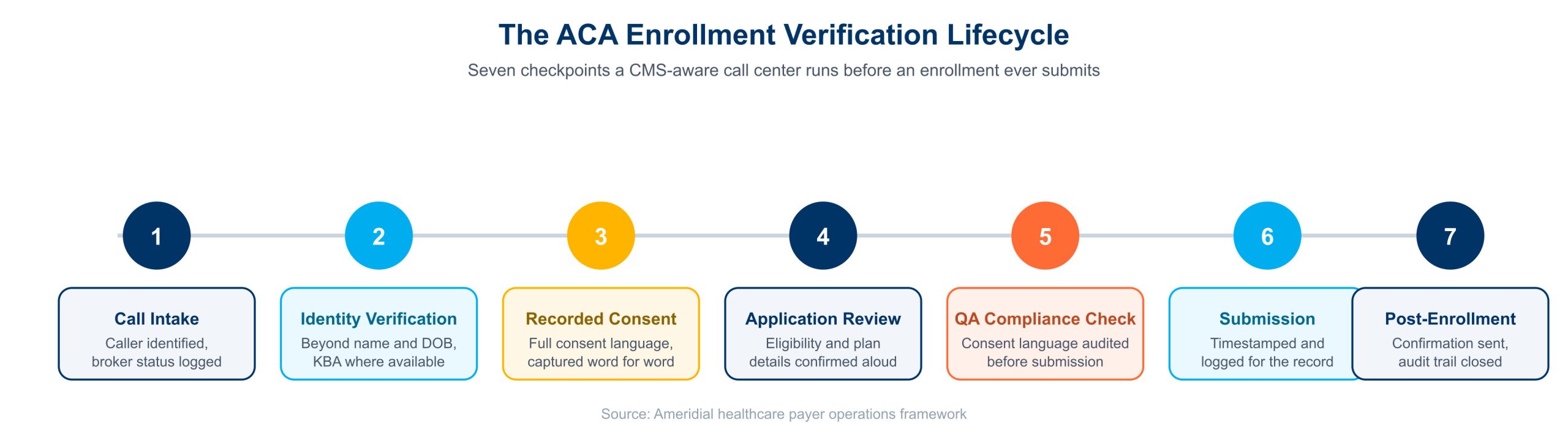
Notably, consent is only one checkpoint among seven, not the entire process. Programs that treat it as the finish line usually skip step five entirely. That missing QA checkpoint is where most unauthorized enrollment complaints actually originate.
Common QA Failures We See Before They Become CMS Complaints
Patterns repeat across enrollment programs more than most vendors admit publicly. Consent language often gets read after the plan selection, not before it. That ordering alone can invalidate the entire consent record under current guidance. Agents sometimes paraphrase required disclosures instead of reading them verbatim. Paraphrasing feels efficient, yet it strips away the exact language regulators expect. Timestamps occasionally get logged at call end rather than at consent capture. That gap makes it nearly impossible to prove when authorization actually occurred. Unassociated broker status frequently goes unchecked before an agent proceeds with changes. Individually, each of these failures looks minor on any single call. Multiplied across thousands of calls per enrollment cycle, they become a pattern. CMS audits are specifically designed to find that exact pattern.
Building an ACA Enrollment Fraud Prevention Call Center From the Ground Up
So what actually works inside a real production environment? The strongest programs treat verification as a layered system, not one line. Identity checks should go beyond a name and date of birth. Knowledge-based authentication helps wherever the marketplace platform allows it. Call recordings must capture full consent language, word for word. No rushed “yes” buried under an enthusiastic sales pitch counts. Quality teams should review a meaningful sample of enrollment calls. That review needs to focus specifically on consent language, not just tone.
Technology helps here, though it never replaces trained, regulation-literate humans. AI-assisted monitoring can flag calls where consent language got rushed. Reviewers can then pull those flagged calls before final submission. That combination catches problems before CMS ever does. Prevention beats reaction every single time in this business.
Ameridial built its healthcare payer operations around exactly this model. The approach pairs CMS-aware agent training with full-interaction quality monitoring. That structure lives inside a broader healthcare payer BPO framework built for regulatory volatility. It reflects the same discipline outlined in Ameridial’s healthcare call center outsourcing guide. That resource walks through how specialized workflows outperform generic support during high-stakes enrollment cycles. The same verification logic shows up in Ameridial’s best practices for TPA enrollment outsourcing. Third-party administrators face nearly identical documentation demands.
From Reactive to Predictive: A Compliance Maturity Model
Naturally, not every program starts at the same readiness level. The model below maps four stages of enrollment verification maturity.
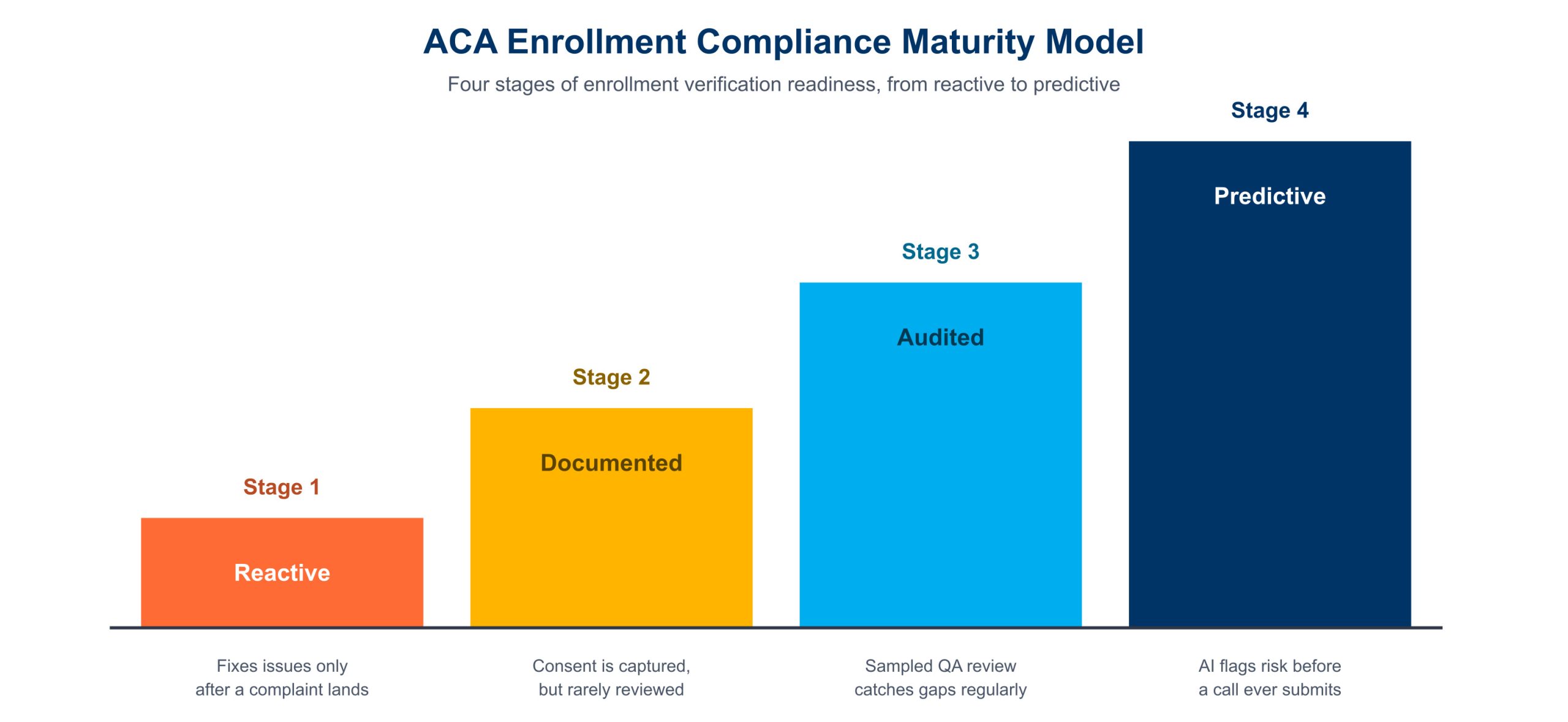
Most in-house teams sit somewhere between stage one and stage two today. Reaching stage three usually requires dedicated QA headcount most internal teams lack. Stage four, where AI flags risk before a call submits, is rare. Programs built for regulated enrollment periods tend to start further along. Ameridial’s AEP enrollment support, for instance, is designed closer to stage three from day one.
Staying Audit-Ready as Unauthorized Enrollment Compliance Healthcare BPO Standards Tighten
Standards will keep tightening well beyond 2026, not loosening. State-based marketplaces already require more identity data upfront than HealthCare.gov historically demanded. Federal rules are gradually catching up to that stricter baseline. Therefore, any verification framework built today should assume future audits will ask harder questions. Documentation that feels excessive now will feel merely adequate within two or three enrollment cycles.
Why Healthcare BPOs Are Becoming CMS’s Favorite Compliance Partner
There is an uncomfortable truth buried inside this crackdown. Many carriers and web-brokers built enrollment infrastructure for speed, not scrutiny. Retrofitting that infrastructure mid-cycle proves both expensive and painfully slow. Partnering with a BPO that already runs auditable workflows solves that problem fast. It skips the multi-year internal rebuild most carriers cannot currently afford.
Furthermore, agencies treating this moment seriously are gaining a real edge. Consumers increasingly ask who is handling their personal data. Brokers and issuers who answer with specifics tend to close more business. They point to consent verification, recorded authorization, and clean audit trails. Trust, it turns out, functions as a growth strategy in disguise.
The 2026 plan year will separate two very different kinds of operators. Some saw this coming and built for it early. Others are still explaining themselves to CMS investigators today. Verification discipline is no longer optional overhead for anyone in this space. It is the difference between a marketplace agreement and a suspension letter.
Get an Audit-Ready Enrollment Program Before Your Next Cycle
A documented verification framework does more than satisfy an auditor. It shortens investigation timelines, reduces clawback exposure, and protects broker relationships. It also gives leadership something rare during CMS scrutiny: a clear paper trail. If your organization needs that kind of audit-ready enrollment program, Ameridial’s healthcare team can help you build one. Request a compliance readiness assessment and see exactly where your current verification process stands. Then walk away with a documented plan for closing the gaps before your next open enrollment cycle begins.