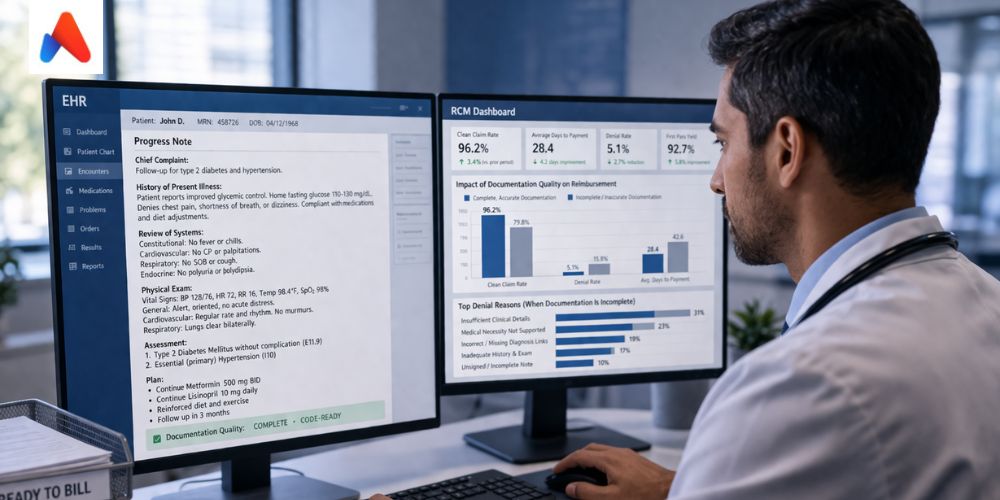






Physician burnout is no longer an isolated workforce issue—it has become a systemic operational risk affecting care quality, revenue cycles, and long-term provider retention. Healthcare organizations today face mounting pressure to balance patient volume with documentation demands, compliance requirements, and administrative overhead.
What often remains underestimated is the financial and operational impact of after-hours charting. Physicians are increasingly spending hours beyond clinical shifts completing electronic health record (EHR) documentation. This “pajama time” not only contributes to fatigue but also impacts productivity, morale, and patient engagement.
For healthcare administrators and practice leaders, the question is no longer whether burnout exists—but how to mitigate it in a scalable, measurable way.
Understanding the True Cost of Physician Burnout
Direct and Indirect Financial Impact
Burnout carries both visible and hidden costs. While turnover expenses and recruitment costs are measurable, indirect losses such as reduced patient throughput, documentation errors, and lower patient satisfaction often go unnoticed.
| Impact Area | Operational Effect |
|---|---|
| Reduced Productivity | Fewer patients seen per day |
| Documentation Delays | Billing and reimbursement slowdowns |
| Physician Turnover | High recruitment and onboarding costs |
| Patient Experience | Lower satisfaction and retention |
A healthcare organization that fails to address these issues risks compounding inefficiencies across multiple departments.
Cognitive Fatigue and Clinical Decision-Making
Beyond operational losses, cognitive overload significantly affects physician performance. When clinicians divide attention between patient care and real-time documentation, it increases the likelihood of incomplete records and missed details.
This dual burden creates a clinical environment where providers operate under constant pressure—impacting both care quality and compliance outcomes.
The Documentation Burden: A Key Driver of Burnout
EHR Complexity and Time Demands
Electronic health record systems were designed to improve efficiency, yet they have introduced new layers of administrative complexity. Physicians often spend nearly as much time documenting as they do interacting with patients.
This imbalance leads to:
- Increased after-hours workload
- Reduced face-to-face patient engagement
- Higher levels of stress and dissatisfaction
~50%
~35%
~15%
The Rise of After-Hours Charting
After-hours charting has become a defining characteristic of modern clinical workflows. It extends the workday, blurs professional boundaries, and reduces recovery time for providers.
For organizations aiming to improve provider retention, addressing documentation workflows is a critical first step.
How Medical Scribing Is Reshaping Clinical Workflows
A Strategic Shift, Not Just Administrative Support
Medical scribing is evolving from a support function into a strategic operational lever. By offloading documentation responsibilities, physicians can refocus on patient care, improving both efficiency and experience.
Medical scribing services outsourcing allows healthcare organizations to introduce structured, scalable documentation support without increasing internal staffing burdens.
Real-Time Documentation and Workflow Optimization
With medical scribe outsourcing services, documentation occurs in real time during patient encounters. This eliminates backlog, reduces after-hours work, and ensures more accurate clinical records.
Key Outcomes of Scribing Integration
| Outcome | Impact |
|---|---|
| Reduced Charting Time | Physicians leave on time |
| Improved Accuracy | Better compliance and coding |
| Increased Throughput | More patients seen per shift |
| Enhanced Patient Interaction | Stronger provider-patient relationships |
Delivery Models: Aligning Scribing with Operational Needs
High-volume clinics
Seamless collaboration
Real-time, in-room
No tech barrier
Multi-location practices
Telehealth-ready
Flexible & scalable
EHR-integrated
Rapid turnaround
Accurate under pressure
Zero clinical disruption
Fast-paced workflow
Live and Onsite Scribing
Live scribing provides in-person documentation support, enabling seamless collaboration between physicians and scribes in high-volume environments.
Virtual Medical Scribing Solutions
Virtual medical scribing solutions offer flexibility and scalability. Remote scribes connect securely to EHR systems, providing real-time documentation without the need for physical presence.
This model is particularly effective for multi-location practices and telehealth environments.
Emergency Room (ER) Scribing
High-acuity settings require rapid documentation and quick turnaround times. Emergency room scribing services support physicians in fast-paced environments, ensuring accurate and timely records without disrupting clinical flow.
Technology Integration: Enabling Scalable Scribing Models
Modern scribing solutions are supported by secure, compliant technology frameworks that integrate with existing healthcare systems.
Secure Connectivity and Compliance
- HIPAA-compliant workflows
- Encrypted data transmission
- Role-based access controls
EHR Integration and Workflow Alignment
Scribing teams operate within the client’s existing EHR environment, ensuring minimal disruption and faster adoption.
Performance Monitoring and Reporting
Operational dashboards and reporting tools allow healthcare leaders to track:
- Documentation turnaround time
- Physician productivity metrics
- Accuracy and compliance benchmarks
These insights enable continuous improvement and measurable ROI.
Why Healthcare Organizations Are Turning to Outsourcing
Healthcare leaders are increasingly recognizing that internal teams alone cannot sustain the growing documentation burden.
Medical scribe outsourcing companies provide specialized expertise, trained resources, and scalable delivery models that align with fluctuating patient volumes.
Key Advantages of Outsourcing
- Reduced administrative burden on physicians
- Scalable workforce without recruitment overhead
- Consistent documentation quality
- Faster implementation compared to in-house hiring
Outsourcing also allows organizations to reallocate internal resources toward strategic initiatives rather than operational bottlenecks.
A Measurable Impact on Physician Retention and Care Quality
Organizations that implement structured scribing programs report significant improvements in both physician satisfaction and operational performance.
“Reducing documentation burden is one of the most effective ways to improve physician engagement and retention.”
When physicians can focus on clinical care rather than administrative tasks, it creates a more sustainable and productive work environment.
Redefining Efficiency in Modern Healthcare
Physician burnout is not just a workforce challenge—it is a signal that clinical workflows need to evolve. Addressing documentation inefficiencies through structured scribing models offers a practical, scalable solution.
By adopting medical device technical support outsourcing-level precision in operational execution and combining it with medical scribing services outsourcing, healthcare organizations can build resilient systems that support both providers and patients.
Build a Sustainable Documentation Model
Healthcare organizations that proactively address documentation challenges are better positioned to improve provider retention, operational efficiency, and patient outcomes.
If your organization is evaluating ways to reduce after-hours charting, improve documentation accuracy, and support physician well-being, it may be time to consider a structured scribing strategy.
A well-designed approach to medical scribe outsourcing services, including virtual medical scribing solutions and emergency room scribing services, can help create a balanced, efficient clinical environment—without adding internal complexity.