





Healthcare leaders no longer treat contact centers as a support function. They now view them as a critical security layer. Every patient conversation, scheduling request, claims inquiry, and medication discussion creates compliance exposure. That reality explains why the modern HIPAA-Compliant Call Center has become central to healthcare operations in 2026.
Healthcare organizations now face stronger cybersecurity expectations, rising ransomware threats, and tighter federal scrutiny. At the same time, patients expect faster responses and digital convenience. Many organizations struggle to balance security with service quality. That pressure has accelerated investment in HIPAA Healthcare Contact Center Services that combine operational discipline with stronger data protection.
The stakes continue to rise because every interaction may involve protected medical data. A single mistake during identity verification, call recording, or messaging can trigger major financial and reputational damage. Healthcare executives now prioritize Protected Health Information Call Center Security alongside operational efficiency. They also recognize that weak governance increases exposure to HIPAA Breach Notification and Compliance penalties.
Healthcare breaches are no longer IT problems.
They are operational failures.
Contact centers now handle scheduling, claims, telehealth coordination, benefits communication, and prescription workflows. Every interaction creates security exposure.
According to the U.S. Department of Health and Human Services, large healthcare breaches affected more than 168 million individuals during 2024 alone. Cyberattacks drove most incidents.
That number shocked healthcare executives because many breaches began with operational gaps rather than sophisticated hacking. Weak authentication procedures, unsecured remote agents, poor vendor oversight, and inconsistent escalation processes often created the opening.
As healthcare operations expand across remote teams, outsourcing partners, and multilingual support environments, security discipline becomes harder to maintain. The organizations succeeding in 2026 are not simply buying software. They are redesigning healthcare communication workflows around compliance, trust, and measurable accountability.
Why 2026 HIPAA Security Expectations Changed Healthcare Contact Centers
The healthcare industry entered 2026 with a very different threat environment. Cybercriminals now target operational teams because they often hold the fastest path to patient data. Contact centers process insurance details, Social Security numbers, treatment discussions, prescription records, and payment information daily.
That operational reality changed executive thinking.
Healthcare organizations once evaluated contact center vendors based on cost and staffing capacity. Today, they prioritize governance frameworks, security protocols, audit readiness, and risk visibility.
The proposed updates to the HIPAA Security Rule increased focus on technical safeguards, workforce accountability, and incident response preparedness.
“Healthcare can no longer separate patient experience from cybersecurity.” – Healthcare Executive from UnitedHealth Group
That statement reflects what many provider groups learned during recent ransomware events. Security failures do not remain isolated inside IT departments. They disrupt scheduling, claims operations, care coordination, and patient communication.
Modern healthcare contact centers therefore require a security-first operating model.
Organizations increasingly evaluate whether outsourcing partners maintain encrypted communications, multi-factor authentication, restricted workstation policies, audit trails, and real-time compliance monitoring. They also assess whether agents receive recurring HIPAA education instead of annual checkbox training.
The strongest outsourcing models now integrate compliance teams directly into operations management. That structure reduces the gap between policy design and frontline execution.
Healthcare Leaders Are Outsourcing Because Internal Operations Are Breaking Down
Healthcare leaders searching for outsourcing support rarely start with cost reduction anymore. Most begin with operational frustration.
Internal teams struggle with staffing gaps, rising call abandonment rates, inconsistent patient experiences, compliance fatigue, and growing cybersecurity pressure. Revenue cycle leaders worry about operational slowdowns after staff turnover. Compliance officers fear vendor mistakes that trigger investigations. Patient access directors face mounting pressure to improve responsiveness without expanding overhead.
Why healthcare organizations are rethinking outsourcing
91%
86%
82%
79%
Many healthcare organizations also feel trapped between two poor choices.
They either overload internal teams and sacrifice service quality, or they outsource aggressively and lose operational visibility. That fear explains why healthcare executives now scrutinize outsourcing providers more aggressively than ever before. They want partners capable of operating like an extension of their organization rather than a disconnected vendor.
Executives increasingly ask:
What Healthcare Leaders Really Look for in an Outsourcing Partner
| Executive Concern | What They Really Want |
|---|---|
| Can this partner protect patient trust? | Secure and compliant workflows |
| Will agents follow protocols consistently? | Structured QA and oversight |
| Can operations scale during spikes? | Workforce flexibility and redundancy |
| Will patient experience decline? | Human-centered healthcare communication |
| Can leadership maintain visibility? | Transparent reporting and governance |
These concerns now shape healthcare outsourcing decisions across providers, payers, pharmacies, and medtech organizations.
The outsourcing providers winning in 2026 are not simply offering labor. They are offering operational stability, governance maturity, and measurable accountability.
Healthcare organizations want confidence that patient communication remains secure even during periods of rapid growth, seasonal surges, cyber incidents, or workforce disruption.
That expectation has permanently changed the outsourcing conversation.
The Operational Cost of Weak Protected Health Information Call Center Security
Many healthcare organizations underestimate how quickly small operational failures escalate.
A rushed verification process may expose medical information to the wrong individual. A remote employee may access records through an unsecured device. An improperly configured screen recording system may capture sensitive information without authorization.
These situations sound minor until regulators become involved.
IBM’s 2025 Cost of a Data Breach Report found healthcare remained the most expensive industry for data breaches globally. The average healthcare breach cost exceeded $9 million.
The financial damage extends far beyond penalties.
Healthcare organizations often face delayed operations, reputational decline, legal expenses, patient attrition, and payer disputes after major incidents. Operational recovery may take months.
A regional health system in the United States experienced severe scheduling disruptions after a ransomware event impacted patient communication systems. Patients lost appointment access for days. Claims operations slowed significantly. Patient satisfaction scores dropped sharply during the following quarter.
The organization later admitted its vendor governance processes lacked consistency.
That scenario explains why healthcare executives increasingly demand deeper operational transparency from outsourcing providers.
Security Failures Often Start with Human Behavior
Technology alone cannot solve compliance risk.
Healthcare contact centers operate in fast-moving environments. Agents manage emotional patient interactions, urgent scheduling requests, benefit explanations, and complex provider coordination. Under pressure, employees may bypass procedures to reduce wait times.
That operational pressure creates hidden vulnerabilities.
Strong HIPAA Healthcare Contact Center Services reduce that risk through layered governance structures. Those programs typically include real-time QA monitoring, restricted workflow permissions, session tracking, identity validation protocols, and escalation oversight.
Many leading healthcare organizations now require role-based access controls for all patient-facing support teams. They also conduct simulated breach exercises to test operational readiness.
The healthcare industry once viewed these practices as enterprise-level luxuries. In 2026, they represent operational necessities.
Why Governance Matters More Than Vendor Promises
Healthcare executives evaluating outsourcing relationships often carry previous frustrations.
Some experienced vendors that scaled too quickly and sacrificed quality. Others dealt with poorly trained agents who mishandled sensitive patient conversations. Several organizations discovered their outsourcing partners lacked healthcare-specific governance experience.
Those failures create skepticism.
Healthcare leaders now want proof before trust.
They expect transparent reporting, operational visibility, secure escalation processes, and leadership accountability. They also expect outsourcing partners to understand healthcare operations beyond scripting and ticket management.
What healthcare leaders now expect from outsourcing partners
That expectation matters because healthcare communication directly impacts reimbursement, patient loyalty, regulatory exposure, and care continuity. When outsourcing providers fail, healthcare organizations absorb the consequences. Patients blame the provider. Regulators investigate the health plan. Physicians lose trust in operational support teams. Revenue cycles slow down. The strongest healthcare outsourcing providers therefore position themselves differently.
They align operations with healthcare outcomes.
That means integrating QA oversight into patient communication workflows, supporting secure omnichannel engagement, maintaining workforce redundancy, and building escalation governance into everyday operations.
Healthcare organizations increasingly prefer partners capable of supporting enterprise-scale operational resilience rather than basic call handling. The Office for Civil Rights continues enforcing breach notification expectations aggressively. Healthcare organizations therefore need outsourcing partners capable of supporting strong HIPAA Breach Notification and Compliance frameworks.
That includes documented escalation procedures, rapid investigation capabilities, and structured communication workflows. The strongest outsourcing partnerships now operate more like strategic extensions of healthcare organizations rather than transactional vendors.
How Modern HIPAA Healthcare Contact Center Services Build Patient Trust
Healthcare consumers now evaluate organizations differently.
Patients expect fast communication, multilingual support, digital convenience, and privacy protection simultaneously. They rarely tolerate long hold times or fragmented experiences.
Yet healthcare organizations often struggle to scale operations internally. That challenge explains growing demand for specialized healthcare outsourcing models.
Modern contact centers now support:
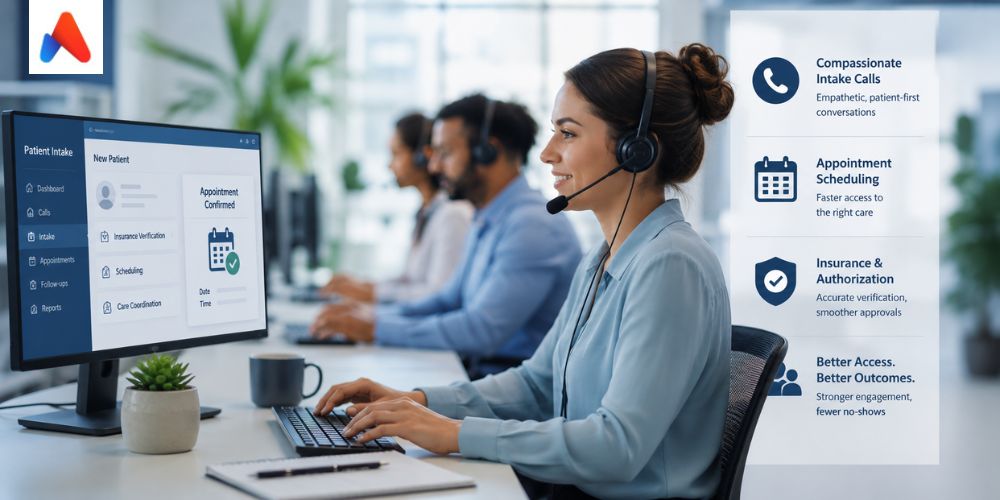
- Patient scheduling and intake coordination
- Prior authorization communication
- Benefits verification workflows
- Claims inquiry management
- Prescription fulfillment support
- Care coordination outreach
- Telehealth engagement support
- Multilingual patient communication
These services require secure workflows because agents routinely access sensitive healthcare information.
Organizations investing in advanced Protected Health Information Call Center Security often see operational advantages beyond compliance.
Secure workflows improve consistency. Standardized authentication reduces errors. Integrated QA systems strengthen documentation quality. Real-time monitoring improves coaching.
These operational gains directly impact patient experience.
A PwC healthcare consumer survey found patients increasingly associate communication quality with care quality itself.
That trend explains why healthcare executives increasingly position contact centers as part of broader patient engagement strategy.
The Technology Layer Now Shapes Competitive Advantage
Technology now plays a larger role in healthcare contact center governance.
Leading organizations increasingly deploy secure cloud infrastructure, encrypted omnichannel communication, automated audit trails, AI-supported QA monitoring, and workforce analytics.
However, technology only succeeds when operational leadership remains strong.
Healthcare organizations often fail when they deploy automation without redesigning workflows. Agents then struggle with fragmented systems and inconsistent escalation rules.
The strongest operational models combine:
- Human-centered training
- Real-time compliance oversight
- Intelligent workflow support
- Structured escalation governance
- Secure data architecture
- Continuous quality management
That combination creates scalability without sacrificing patient trust.
Healthcare organizations increasingly seek outsourcing partners capable of supporting both operational growth and compliance resilience.
The Future of HIPAA-Compliant Healthcare Operations
Healthcare operations will become even more interconnected during the next several years.
Remote patient monitoring, digital scheduling, omnichannel communication, telehealth expansion, and multilingual engagement will continue increasing data complexity.
At the same time, regulatory expectations will tighten further.
Healthcare organizations therefore need contact center strategies designed for long-term resilience rather than short-term staffing relief.
The most successful healthcare leaders already understand this shift.
They no longer ask whether compliance matters. They ask whether their operational model can withstand regulatory scrutiny, cyber threats, patient expectations, and rapid growth simultaneously.
That question now shapes outsourcing decisions across healthcare providers, health plans, pharmacies, and medtech organizations.
Organizations seeking scalable healthcare communication support increasingly prioritize operational maturity, governance transparency, and patient trust.
Those priorities will define healthcare outsourcing success throughout 2026 and beyond.
Healthcare organizations are no longer outsourcing for cost alone.
They are outsourcing for resilience, governance, workforce stability, cybersecurity readiness, and patient trust.
The modern HIPAA-Compliant Call Center has evolved into a frontline defense layer for healthcare organizations. Security expectations now extend far beyond technical infrastructure. They influence workforce governance, patient engagement, operational continuity, and brand reputation.
Healthcare leaders evaluating outsourcing strategies must now assess whether providers can deliver secure, scalable, and patient-centered operations simultaneously. Strong HIPAA Healthcare Contact Center Services combine governance discipline, operational intelligence, and human empathy. They also strengthen Protected Health Information Call Center Security while supporting faster patient communication.
As cyber threats continue evolving, healthcare organizations cannot afford fragmented oversight or reactive compliance strategies. Strong operational governance now directly impacts patient trust, regulatory readiness, and long-term business resilience. Organizations that prioritize structured HIPAA Breach Notification and Compliance frameworks today will remain far better prepared for tomorrow’s healthcare environment.
Ready to Strengthen Your Healthcare Operations Without Increasing Compliance Risk?
Healthcare organizations cannot afford fragmented patient communication, weak security oversight, or inconsistent operational workflows in 2026. The right HIPAA-Compliant Call Center partner helps reduce operational pressure while protecting patient trust, improving responsiveness, and supporting long-term compliance resilience.
Ameridial helps healthcare providers, payers, pharmacies, and medtech organizations build secure, scalable, and patient-focused support operations through specialized HIPAA Healthcare Contact Center Services designed for today’s regulatory environment.
Whether your organization needs stronger Protected Health Information Call Center Security, better workforce scalability, multilingual patient engagement, or structured HIPAA Breach Notification and Compliance support, Ameridial delivers enterprise-grade governance with human-centered healthcare service.
Schedule a Healthcare Compliance Operations Assessment and discover how secure outsourcing can improve both patient experience and operational performance.