




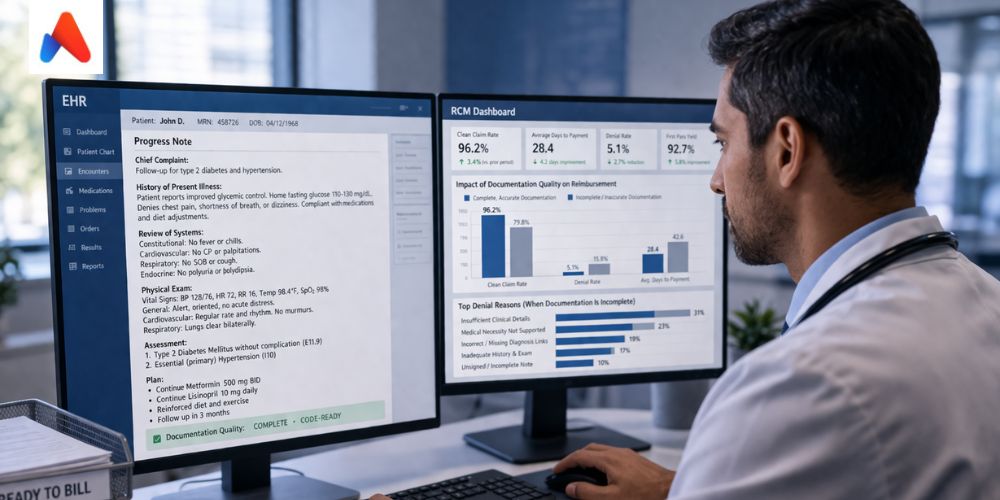
In today’s healthcare environment, financial performance is closely tied to documentation accuracy. While revenue cycle strategies often focus on coding, billing, and collections, the process begins much earlier—at the point of care.
Accurate electronic health record (EHR) documentation directly impacts claim acceptance, reimbursement timelines, and compliance outcomes. When documentation is incomplete, inconsistent, or delayed, it creates downstream inefficiencies that affect both clinical and financial operations.
For healthcare leaders evaluating medical scribing services outsourcing and revenue cycle optimization, the connection between documentation and reimbursement is no longer optional—it is foundational.
The Link Between Clinical Documentation and Revenue Cycle Performance
From Encounter to Claim Submission
Every patient encounter generates data that must be translated into billable codes. This process depends on clear, structured, and complete documentation.
When documentation is accurate:
- Coding teams can assign appropriate codes without delays
- Claims are submitted faster
- Payers process claims with fewer queries or rejections
When documentation is incomplete, the entire revenue cycle slows down.
The Hidden Cost of Documentation Gaps
| Documentation issue | Revenue cycle impact |
|---|---|
| Missing details | Coding delays and queries |
| Inconsistent terminology | Claim denials or rework |
| Late chart completion | Delayed billing cycles |
| Compliance gaps | Audit risks and penalties |
These inefficiencies create a ripple effect, increasing administrative workload while reducing cash flow predictability.
What Goes Wrong Without Accurate EHR Documentation
Coding Errors and Revenue Leakage
Incomplete or unclear documentation forces coding teams to make assumptions or seek clarifications. This increases the risk of undercoding, overcoding, or claim rejection.
Over time, these issues contribute to significant revenue leakage and operational inefficiency.
Claim Denials and Rework Cycles
Denied claims often stem from documentation deficiencies rather than payer policies. Missing clinical justification, lack of specificity, or incomplete notes can result in repeated submission cycles.
Impact on Operations
- Increased administrative burden
- Longer accounts receivable (AR) cycles
- Higher cost to collect
Delayed Reimbursement Timelines
When charts are not completed promptly, billing teams cannot proceed with claim submission. This delay directly affects cash flow and financial planning.
In high-volume environments, even small delays can accumulate into significant revenue bottlenecks.
How Accurate Documentation Accelerates Reimbursement
Improved Coding Accuracy and Speed
Clear and complete documentation enables coding teams to work efficiently without repeated clarifications. This reduces turnaround time and improves first-pass claim acceptance rates.
Faster Claim Submission and Processing
With accurate documentation, claims move through the revenue cycle with fewer interruptions. Payers receive complete information, reducing the likelihood of rejections or additional documentation requests.
Stronger Compliance and Audit Readiness
Accurate records ensure that organizations meet regulatory requirements and are prepared for audits. This reduces risk exposure while maintaining financial integrity.
“Documentation quality is not just a clinical requirement—it is a direct driver of financial performance.”
The Role of Medical Scribing in Documentation Accuracy
Real-Time Documentation Support
Medical scribe outsourcing services enable real-time capture of patient encounters, ensuring that documentation is complete and accurate at the point of care.
This approach reduces reliance on after-hours charting and minimizes the risk of missing or incorrect information.
Standardization Across Clinical Workflows
Scribing teams follow structured documentation protocols, ensuring consistency across providers and departments.
This standardization improves coding accuracy and supports smoother revenue cycle operations.
Integration with Revenue Cycle Processes
Accurate documentation directly supports downstream functions such as coding, billing, and denial management.
Organizations leveraging medical scribing services outsourcing often experience improved alignment between clinical and financial workflows.
Technology as an Enabler of Documentation and Revenue Efficiency
EHR Integration and Workflow Alignment
Scribing solutions operate within existing EHR systems, ensuring that documentation aligns with coding and billing requirements from the outset.
Data Accuracy and Validation
Technology-enabled workflows support structured data entry, reducing variability and improving data quality.
Performance Monitoring and Reporting
Healthcare leaders can track key metrics such as:
- Documentation turnaround time
- First-pass claim acceptance rates
- Denial rates linked to documentation issues
These insights provide a clear view of how documentation impacts financial outcomes.
Why Healthcare Organizations Are Turning to Outsourcing
Managing documentation accuracy internally can be resource-intensive and difficult to scale. As patient volumes fluctuate, maintaining consistent documentation quality becomes increasingly challenging.
Medical scribe outsourcing companies offer specialized expertise, trained resources, and scalable delivery models that align with both clinical and revenue cycle needs.
Key Benefits of Outsourcing Documentation Support
- Reduced documentation burden on physicians
- Improved accuracy and completeness of records
- Faster coding and billing processes
- Enhanced revenue cycle efficiency
Outsourcing allows organizations to focus internal resources on patient care and strategic initiatives while ensuring documentation excellence.
A Unified Approach: Connecting Clinical and Financial Performance
Healthcare organizations that treat documentation and revenue cycle management as separate functions often encounter inefficiencies. A unified approach ensures that documentation quality supports financial performance from the start.
By aligning medical scribe outsourcing services with revenue cycle operations, organizations can create a seamless workflow from patient encounter to reimbursement.
Turning Documentation into a Financial Advantage
Accurate EHR documentation is more than a compliance requirement—it is a strategic asset that drives revenue cycle efficiency, reduces denials, and accelerates reimbursement.
Organizations that invest in structured documentation support, including medical scribing services outsourcing, are better positioned to achieve operational and financial stability.
The goal is not just to document care, but to ensure that every encounter translates into accurate, timely, and complete reimbursement.
Strengthen Your Documentation and Revenue Strategy
If your organization is experiencing delays in reimbursement, rising denial rates, or documentation inconsistencies, it may be time to reassess your approach.
A structured model that incorporates medical scribe outsourcing services and aligns with revenue cycle workflows can help improve accuracy, speed, and financial outcomes.
The next step is to build a documentation strategy that supports both clinical excellence and revenue performance—without adding operational complexity.
Explore Ameridial Medical Scribing Solutions