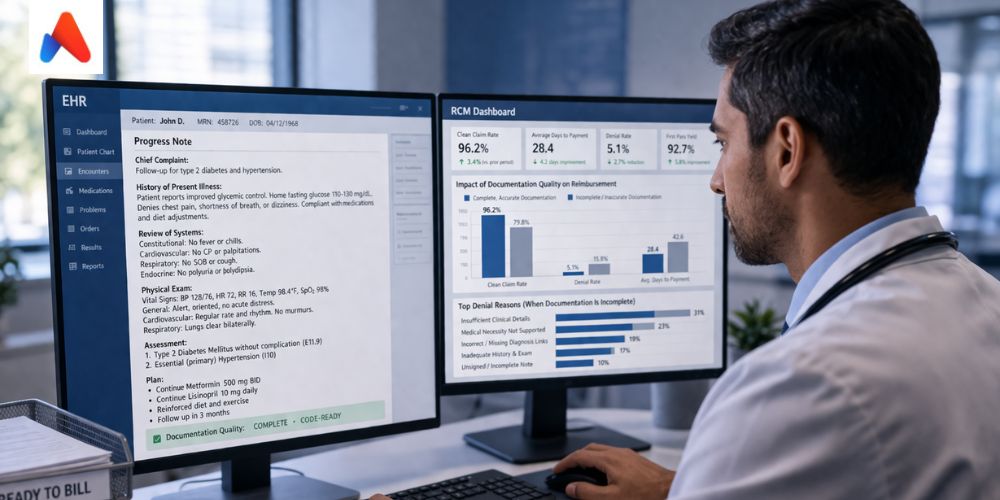






Healthcare organizations are under increasing pressure to optimize clinical workflows while maintaining documentation accuracy, compliance, and provider satisfaction. As documentation demands continue to grow, many organizations are evaluating medical scribing services outsourcing as a long-term solution.
However, selecting the right delivery model—live, virtual, or AI-assisted—requires more than a surface-level comparison. Each model impacts workflow efficiency, physician experience, scalability, and operational cost in different ways.
For decision-makers, the challenge is not just adopting scribing support, but aligning the model with clinical realities, patient volumes, and long-term operational goals.
Understanding the Three Core Medical Scribing Models
Live Medical Scribing: Embedded Clinical Support
Live scribing involves trained professionals working physically alongside physicians within clinical settings. This model allows real-time documentation during patient encounters, enabling seamless collaboration.
Key Characteristics
- In-person presence within the care environment
- Immediate interaction with providers
- Strong alignment with high-touch clinical workflows
Operational Considerations
While live scribing enhances communication and workflow integration, it also introduces challenges related to staffing, space constraints, and scalability. Organizations must account for onboarding time, scheduling complexities, and facility limitations.
Virtual Medical Scribing Solutions: Scalable and Flexible Support
Virtual medical scribing solutions provide real-time documentation support remotely through secure connectivity. Scribes access patient encounters via audio or video feeds and document directly within the EHR system.
Key Characteristics
- Remote delivery with secure system access
- Real-time documentation without physical presence
- Rapid scalability across locations
Operational Considerations
Virtual models reduce infrastructure requirements and allow healthcare organizations to scale quickly without increasing on-site staffing. They are particularly effective for multi-specialty practices, telehealth environments, and distributed care networks.
AI-Assisted Medical Scribing: Technology-Enabled Documentation Support
AI-assisted scribing introduces technology-driven documentation workflows that support or augment human scribes. These systems capture and structure clinical conversations, which are then reviewed and finalized.
Key Characteristics
- Technology-enabled documentation capture
- Structured data extraction from clinical interactions
- Integration with human oversight for accuracy
Operational Considerations
While AI-assisted models offer efficiency gains, they require strong governance, quality control, and integration with clinical workflows. Accuracy, compliance, and physician trust remain critical factors in adoption.
Comparative Analysis: Evaluating What Matters Most
Performance Across Key Operational Metrics
| Criteria | Live scribing | Virtual scribing | AI-assisted scribing |
|---|---|---|---|
| Real-time accuracy | High | High | Moderate |
| Scalability | Limited | High | Very high |
| Implementation speed | Moderate | Fast | Moderate |
| Cost efficiency | Moderate | High | Variable |
| Workflow disruption | Low | Very low | Moderate |
This comparison highlights that no single model fits all scenarios. The optimal choice depends on clinical complexity, patient volume, and organizational priorities.
Aligning Scribing Models with Practice Needs
High-Volume Clinical Environments
Emergency departments and high-throughput clinics often benefit from emergency room scribing services or live scribing models, where immediate collaboration is critical.
Multi-Location and Telehealth Practices
For organizations operating across multiple locations, virtual medical scribing solutions provide consistency and scalability without adding physical infrastructure.
Technology-Forward Organizations
Practices investing in digital transformation may explore AI-assisted models to complement human documentation workflows, particularly for structured data capture and analytics.
Technology Infrastructure: The Backbone of Effective Scribing
Successful implementation of any scribing model depends on robust technology integration.
Secure and Compliant Frameworks
- HIPAA-compliant systems
- End-to-end encryption
- Controlled access protocols
Seamless EHR Integration
Effective scribing requires direct interaction with existing EHR platforms, minimizing workflow disruption and accelerating adoption.
Performance Visibility and Analytics
Modern scribing programs incorporate reporting tools that track:
- Documentation turnaround time
- Physician productivity improvements
- Accuracy and compliance metrics
These insights enable healthcare leaders to make data-driven decisions and continuously refine their documentation strategies.
The Role of Outsourcing in Model Selection
Healthcare organizations increasingly rely on medical scribe outsourcing services to access specialized expertise and flexible delivery models.
Medical scribe outsourcing companies provide the ability to deploy live, virtual, or hybrid solutions based on evolving operational needs.
Why Outsourcing Enables Better Decision-Making
- Access to trained and certified scribes
- Faster implementation timelines
- Flexibility to switch or combine models
- Reduced administrative and recruitment burden
Outsourcing also allows organizations to pilot different models without long-term internal commitments, reducing risk while improving outcomes.
Building a Hybrid Approach: A Practical Path Forward
Many healthcare organizations are moving toward hybrid scribing models that combine the strengths of multiple approaches.
Surgical units
High-touch clinical care
Telehealth environments
Distributed care networks
Analytics & reporting
Documentation consistency
This blended approach allows organizations to optimize workflows while maintaining flexibility and control.
A Strategic Perspective: Beyond Documentation Support
Scribing is no longer just an operational necessity—it is a strategic enabler of physician efficiency, patient experience, and organizational performance.
“The right documentation model does not just reduce workload—it reshapes how care is delivered.”
Healthcare leaders who take a structured, consultative approach to selecting scribing models are better positioned to achieve sustainable improvements.
Making the Right Choice for Long-Term Impact
Choosing between live, virtual, and AI-assisted scribing is not a one-time decision. It requires ongoing evaluation, alignment with clinical workflows, and a clear understanding of organizational goals.
By leveraging medical scribing services outsourcing, healthcare organizations can adopt flexible, scalable models that evolve with their needs.
The focus should not be on selecting a single model, but on building a documentation strategy that supports efficiency, accuracy, and provider satisfaction.
Evaluate Your Scribing Strategy
If your organization is assessing how to reduce documentation burden while improving operational performance, it may be time to evaluate your current approach.
A structured strategy that includes medical scribe outsourcing services, virtual medical scribing solutions, and emergency room scribing services can help align documentation workflows with clinical and business objectives.
The next step is to identify the model—or combination of models—that best supports your practice environment, scalability needs, and long-term growth objectives.
Explore Ameridial Medical Scribing Solutions